Process Systems Engineering Webinars
Webinars consist of applications and tutorials in process systems engineering on topics such as mathematical modeling, estimation, control, and optimization. The sessions are hosted with interactive chat, video conferencing, and remote computer desktop sharing. Each of the sessions is recorded and later posted online. Sessions are sponsored by the Computing and Systems Technology (CAST) division of the American Institute of Chemical Engineers (AIChE) as the WebCAST series.

| Topic | Date / Time | Presenter | Affiliation |
| Systems Engineering for Energy System Operation and Design | Tues Sept 22, 2026 10 AM ET |
Christos Maravelias | Princeton |
| Advances in Industrial Modeling and Optimization Applications | Tues Oct 27, 2026 11 AM ET |
Dimitrios Varvarezos | Emerson AspenTech |
| Discovery of Decision-making Mechanisms via Data-driven Inverse Optimization | Tues Jan 26, 2027 11 AM ET |
Rishabh Gupta | University of Minnesota ExxonMobil |
| Early-Stage Integrated Process & Product Design | Tues Feb 23, 2027 11 AM ET |
Alexander Mitsos | RWTH Aachen University |
| Open Textbooks and AI Curriculum Development for Computer-Based Chemical Engineering Education | Tues Mar 16, 2027 11 AM ET |
Fengqi You | Cornell University |
- Select Presentation Title to Join Session
- Visit YouTube Playlist for recordings
- Nominate a seminar speaker

To participate in an upcoming presentation, click the link above to join the webinar session. There is no charge to join the webinar and Windows, Linux, iOS, and mobile platforms are supported. Presentations are recorded and posted to YouTube as is the case with many of the past sessions shown below.
Past Presentations - 2026
| Topic | Presentation | Date | Presenter | Affiliation |
| MINLP Techniques for Design of Separation Systems | 
| Tues July 14, 2026 |
Radhakrishna Tumbalam Gooty | KeyLogic Systems at National Energy Technology Laboratory |
| Interactive Textbooks for Chemical Engineering: Engagement and Learning in the 21st Century | 
| Tues June 9, 2026 |
Matthew Liberatore | Trine University |
| Interactive Textbooks for Chemical Engineering: Engagement and Learning in the 21st Century |
| Tues June 9, 2026 |
Matthew Liberatore | Trine University |
| Process Systems Engineering for Gene Therapy Manufacturing | 
| Tues May 12, 2026 |
Francesco Destro | BioCurie |
| Advanced Manufacturing Systems and Control | 
| Tues Apr 7, 2026 |
Richard Braatz | MIT |
| Surrogate Models and Generative AI with AVEVA | 
| Thurs Mar 12 |
Mihaela Hahne Ryan Muir |
AVEVA |
| Combining AI and Domain Expertise to Solve the Process Industry's Most Challenging Problems | 
| Tues Feb 17 |
Devin Griffith | AspenTech Emerson |
Past Presentations - 2025
| Topic | Presentation | Date | Presenter | Affiliation |
| Toward Explainable Stochastic Optimization for Decision Making Under Uncertainty AIChE CAST Division Outstanding Young Researcher Award | 
| Tues Feb 25 | Qi Zhang | University of Minnesota |
| An Overview of Courses, Tools, and Lessons from the Data Sciences for the Chemical Industry Graduate Certificate Program David Himmelblau Award for Innovations in Computer-Based Chemical Engineering Education | 
| Tues Feb 18 | Andrew Medford Fani Boukouvala Martha Grover | Georgia Tech |
| Large Language Models for Chemical Engineering W. David Smith, Jr. Graduate Publication Award | 
| Tues Feb 4 | Artur Schweidtmann | TU Delft |
Past Presentations - 2024
| Topic | Presentation | Date | Presenter | Affiliation |
| Investigating the Intersection of Control Algorithms with Quantum Computation | 
| Tues Nov 12 | Helen Durand | Wayne State University |
| (Teaching) Control Theory in the Age of Machine Learning | 
| Oct 23 | Steven Brunton | University of Washington |
| Synthesis of Sustainable Process Intensification Systems | 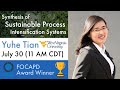
| Jul 30 | Yuhe Tian | West Virginia University |
| Transformer-based Hybrid Modeling and Control of Evolving, Nonlinear Processes | 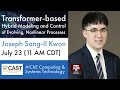
| Jul 23 | Joseph Kwon | Texas A&M |
| Systems Design to Enable a Net-Zero Circular Economy | 
| Jun 4 | Vyom Thakker | Machine Learning, Optimization & Statistics (MiLOS) at Dow |
| The Future of Process Systems Engineering is Sustainability | 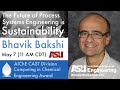
| May 7 | Bhavik Bakshi | Arizona State University |
| Large-Scale Nonlinear Programming on GPUs: State-of-the-Art and Future Prospects | 
| Apr 11 | Sungho Shin | Argonne / MIT |
| Contents Under Pressure: A Virtual Teaching Environment | 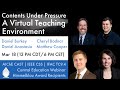
| Mar 18 | Daniel Burkey Daniel Anastasio Cheryl Bodnar Matthew Cooper | UCONN RHIT Rowan NCSU |
| Exergy Analysis for Energy Systems | 
| Feb 8 | Thomas Adams II | NTNU |
| Data-Driven Engineering and Process Control Education with Portable Labs | 
| Jan 24 | John Hedengren | Brigham Young University |
Past Presentations - 2023
| Topic | Presentation | Date | Presenter | Affiliation |
| Generative AI for Process Systems Engineering | 
| Nov 1 | John Hedengren | Brigham Young University |
| Design of Dynamic Experiments, Data-Driven Dynamic Models, and Optimization of Batch Processes CAST Division Distinguished Service Award Winner | 
| Jan 31 | Christos Georgakis | Tufts University |
| Data + PSE Principles and Applications CAST Division Computing in Chemical Engineering Award Winner | 
| Jan 24 | S. Joe Qin | City University of Hong Kong Lingnan University President Elect |
Past Presentations - 2022
| Topic | Presentation | Date | Presenter | Affiliation |
| Interactive Computing Activities as Chemical Engineering Educational Tools in University and Informal Learning Environments CAST Division David Himmelblau for Innovations in Computer-Based Chemical Engineering Education Award Winner | 
| Dec 20 | Ashlee N. Ford Versypt | University at Buffalo, The State University of New York |
| Classification and Behavioral Severity Prediction of Autism Spectrum Disorder using Blood-based Measurements CAST Division W. David Smith, Jr. Graduate Publication Award Winner | 
| Dec 13 | Daniel Howsmon | University of Texas at Austin |
| An Efficient Optimization under Uncertainty Framework for Static and Dynamic Sensor Placement with Real-world applications to Power Systems, Water Distribution Networks, and Air Pollution Monitoring CAST Division Computing Practice Award Winner | 
| Dec 1 | Urmila Diwekar | Vishwamitra Research Institute |
| Teaching Conceptual Process Flowsheeting and Simulation | 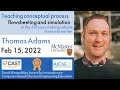
| Feb 15 | Thomas Adams | McMaster University |
| Sustainable Process Synthesis and Intensification of Chemical Enterprises (SPICE) | 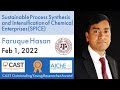
| Feb 1 | Faruque Hasan | Texas A&M |
Past Presentations - 2021
| Topic | Presentation | Date | Presenter | Affiliation |
| System Identification with Industrial Data | 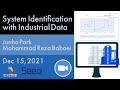 | Dec 15 | Junho Park Mohammad Reza Babaei | Brigham Young University |
| Extraterrestrial Drilling: How on Earth can Martian Drilling Help Us? | 
| Dec 9 | Alfred William (Bill) Eustes III | Colorado School of Mines |
| Global Flowsheet Optimization: Reduced-Space Formulations, Relaxations & Parallelization | 
| Nov 30 | Dominik Bongartz | RWTH Aachen University |
| Molecular Level Decisions for Design and Optimisation AIChE CAST Awards | 
| Nov 18 | Claire Adjiman | Imperial College London |
| Data Analytics in Oil and Gas | 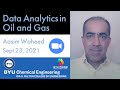
| Sep 23 | Aasim Waheed | Director of Automation |
| Data Science for Energy Applications | 
| Apr 14 | Derrick Turk | Terminus Data Science LLC |
| Break Into Data Science | 
| Apr 7 | Avery Smith | Snow Data Science |
| Advanced Analytics in the Process Industry | 
| Mar 25 | Ashwin Venkat | Seeq |
| Teaching System Identification to Chemical Engineers | 
| Feb 25 | Daniel E. Rivera AIChE CAST Division Himmelblau Award Recipient | Arizona State University |
Past Presentations - 2020
| Topic | Presentation | Date | Presenter | Affiliation |
| Sustainable Process Design Through Multiscale Process Integration | 
| Nov 24 | Mahmoud El-Halwagi AIChE CAST Division Computing in Chemical Engineering Award | Texas A&M |
| Recognizing and Sustaining Process Control Value | 
| Nov 12 | Moderator Mark Darby Panel Greg McMillan Don Bartusiak Brian Ashcraft Raymond Coker Sebastien Osta | Panel Discussion |
| Towards Autonomous Operations of Hydrocarbon Processing | 
| Oct 8 | Simon Rogers | Vice President Digital Solutions at Yokogawa |
| Reinforcement Learning for Process Control and Beyond | 
| Jul 16 | Jay H. Lee 21st IFAC World Congress Plenary | KAIST |
| Process Control Distance Education | 
| Mar 17 | Brian Douglas Steve Brunton Anthony Rossiter Jeff Kantor | Panel Discussion |
| Chemical Engineering Online Learning | 
| Mar 12 | John L. Falconer | University of Colorado |
| Energy Efficiency, Smart Grids, and Process Control | 
| Feb 21 | Thomas F. Edgar | The University of Texas at Austin |
| Power Systems of the Future: Perspectives on Carbon Emissions and Power Production | 
| Feb 20 | Thomas F. Edgar | The University of Texas at Austin |
Past Presentations - 2019
| Topic | Presentation | Date | Presenter | Affiliation |
| Maximizing Our Impact: Techno-economic analyses for sustainable energy | 
| Nov 26 | Thomas A. Adams II | McMaster University |
| Teaching Process Dynamics & Control | 
| Oct 29 | John Hedengren | Brigham Young University |
Past Presentations - 2018
| Topic | Presentation | Date | Presenter | Affiliation |
| Introduction to ICS (Industrial Control System) Cybersecurity | 
| Nov 27 | Eddie Habibi | PAS Global |
| GEKKO Optimization Suite (WebEx), Overview (YouTube) | 
| Aug 23 | Logan Beal | Brigham Young University |
| Tailored Indirect Algorithms for Efficient On-Line Optimization | 
| April 17 | Erdal Aydin | Max Planck Institute for Dynamics of Complex Technical Systems |
| Arbitrary Polynomial Chaos for Uncertainty Quantification of Correlated Random Variables in Nonlinear Systems | 
| March 13 | Ali Mesbah | University of California, Berkeley |
| Towards the Development of a Diagnostic Test for Autism Spectrum Disorder: Big Data Meets Metabolomics | 
| Feb 6 | Juergen Hahn | Rensselaer Polytechnic Institute |
Past Presentations - 2017
| Topic | Presentation | Date | Presenter | Affiliation |
| Dynamic Optimization Modeling using CasADi | 
| Nov 14 | Joel Andersson | University of Wisconsin-Madison |
| Pocket-Sized Heat Transfer Lab for Dynamics and Control | 
| Oct 10 | John Hedengren Abe Martin Jeffrey Kantor | Brigham Young University University of Notre Dame |
| When Machine Learning Meets Robust Optimization: Data-driven Adaptive Robust Optimization Models, Algorithms & Applications | 
| Sept 20 | Fengqi You | Cornell University |
| Inverted-classroom Approaches to Educate Undergraduate and High-school Students MATLAB in Process Control and Modeling | 
| May 9 | Zuyi (Jacky) Huang | Villanova University |
| Nonlinear Programming at Small Scales: Doing More with Less | 
| Apr 25 | Victor Zavala | University of Wisconsin-Madison |
Past Presentations - 2016
| Topic | Presentation | Date | Presenter | Affiliation |
| Making Sense of Drilling Operations | 
| Nov 15 | Roar Nybø | SINTEF |
| Robust Control of Unexpected Gas Influx During Drilling | 
| June 21 | Ulf Jakob Aarsnes | NTNU / IRIS |
| Virtual Arena for Drilling and Well Operations | 
| May 25 | Jan Einar Gravdal | IRIS |
| Nonlinear Optimization Modeling using JuMP and JuliaOpt | 
| April 5 | Miles Lubin | MIT |
| A Chemical Engineer's perspective on health and disease - From low level targets to engaging systemic mechanisms | 
| March 8 | Ioannis (Yannis) P. Androulakis | Rutgers University |
Past Presentations - 2015
| Topic | Presentation | Date | Presenter | Affiliation |
| Wax Deposition | AIChE ChemE On Demand | Nov 4 | Zhenyu (Jason) Huang | Assured Flow Solutions LLC |
| Mobile Apps for Chemical Engineering Education | 
| Sept 8 | Jason Bara | University of Alabama |
| Equation Oriented Dynamic Modeling: A Perspective on Progress and Challenges | 
| June 9 | Jeff Renfro | Honeywell Process Solutions |
| Modeling for Advanced Pharmaceutical Manufacturing | 
| May 19 | Marianthi Ierapetritou | Rutgers University |
| Nonlinear Model Predictive Control of an Industrial Polymerization Process | 
| Feb 24 | Rahul Bindlish | Dow |
| From the Nanometer Scale to the Oilfield: Applying Fundamental Asphaltene Research | AIChE ChemE On Demand | Feb 4 | Michael Hoepfner | University of Utah |
| Advances in Chemical Production Scheduling | 
| Jan 27 | Christos Maravelias | University of Wisconsin-Madison |
| Dynamic Emulsion Characterization | AIChE ChemE On Demand | Jan 21 | Clint Aichele | Oklahoma State University |
Past Presentations - 2014
| Topic | Presentation | Date | Presenter | Affiliation |
| GREENSCOPE – A Comprehensive and Systematic Sustainability Evaluation Tool for Chemical Processes | 
| Dec 2 | Raymond L. Smith | Environmental Protection Agency (EPA) |
| Dynamic Modeling and Optimization Advances with gPROMS | 
| Oct 14 | Pieter Schmal | PSE |
| Control of Artificial Pancreas Systems | 
| Sept 16 | Ali Cinar | Illinois Institute of Technology |
| Structured Optimization Modeling with Pyomo and Coopr | 
| June 24 | John Siirola | Sandia National Laboratories |
| Better Optimization of Nonlinear Uncertain Systems (BONUS) Algorithm for Large Scale Real World Stochastic Nonlinear Programming Problems | 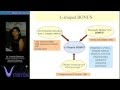
| June 17 | Urmila Diwekar | Vishwamitra Research Institute |
| The Nexus of Energy and Water | May 28 | Michael Webber | The University of Texas at Austin | |
| Meters to Models: Using Smart Meter Data to Predict and Control Home Energy Use | 
| Apr 15 | Krystian Perez | University of Texas at Austin |
| Multi-echelon Supply Chain Inventory Optimization | 
| Mar 25 | Anshul Agarwal | Dow Chemical |
| Parallel Computing and Opportunities in Nonlinear Optimization | 
| Mar 11 | Carl Laird | Purdue University |
| Global Optimization of MINLP by Evolutionary Algorithms | 
| Feb 25 | Martin Schlueter | Hokkaido University, Japan (MIDACO) |
| Industrial Flowsheet Optimization and Estimation using IMPL | 
| Feb 18 | Jeffrey Kelly | Industrial Algorithms |
| Feedback Control of Stochastic Self-Assembly | 
| Feb 11 | Martha Grover | Georgia Tech |
| New Interface Developments with the AMPL Modeling Language & System | 
| Jan 28 | Robert Fourer | Northwestern University |
| Stochastic Optimal Control for Gas Networks | 
| Jan 21 | Victor Zavala | Argonne National Laboratory |
| Process Integration & Optimization Using Dynamic Systems Models |  Presentation | Jan 14 | Richard Boardman Humberto Garcia | Idaho National Laboratory |
Past Presentations - 2013
| Topic | Presentation | Date | Presenter | Affiliation |
| A Dynamic Optimization Framework with Economic MPC for Energy Capacity Planning | 
| Dec 3 | Jose Mojica | Brigham Young University |
| Multicomponent Prediction Methods for Hanford Nuclear Waste | 
| Nov 19 | Jacob Reynolds | Washington River Protection Solutions |
| Advanced Deep Water Monitoring Systems |  Presentation | Nov 7 | David Brower | Astro Technology, Inc. |
| Improved Grid Management through Predictive Residential Air Conditioning Control | 
| Oct 31 | Wesley Cole | The University of Texas at Austin |
| Tuning the Static and Dynamic Performance of Microchannel Reactors | 
| Oct 22 | Richard Pattison Michael Baldea | The University of Texas at Austin |
| Leapfrog Applications in APC and Plant Optimization | 
| Oct 15 | Anand Govindarajan Upasana Manimegalai-Sridhar R. Russell Rhinehart | Oklahoma State University |
| Tutorial on Bayesian Approaches for State and Parameter Estimation | 
| Oct 8 | Bhushan Gopaluni | University of British Columbia, Vancouver |
| Prospects and Challenges for Olefins Production Speaker Introduction Discussion Topics | 
| Oct 3 | Mark Darby Doug Nicholson Judson Wooters Richard Hughes | CMiD Solutions APEX Optimization Chevron Phillips SABIC UK |
| Future Polygeneration Systems | 
| Sept 24 | Thomas Adams, II | McMaster University |
| Research and Careers in Reservoir Engineering | 
| Sept 10 | Hugh Hales | Brigham Young University |
| Monitoring, Control, and Optimization of Energy Infrastructure | 
| Aug 26 | Reza Asgharzadeh Shishivan | Brigham Young University |
| Dynamic Optimization of a Solid Oxide Fuel Cell | 
| July 2 | Lee Jacobsen | ExxonMobil Chemical BYU |
| Stimulation Optimization of Unconventional Resources | 
| Jan 18 | Marisela Sanchez-Nagel | Itasca Houston, Inc |
Past Presentations - 2012
| Topic | Presentation | Date | Presenter | Affiliation |
| Efficient Surrogate Model Generation | 
| Nov 13 | John Eason and Selen Cremaschi | Univ of Tulsa |
| Fast NMPC and MHE tools | 
| Nov 6 | Milan Vukov Moritz Diehl | KU Leuven |
| Proactive Energy Management Strategies for Buildings | 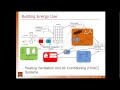
| Oct 23 | Cara R. Touretzky Michael Baldea | UT Austin |
| Mixed Integer Nonlinear Programming |  
| Oct 2 | Wesley Cole Jeremy Castagno | UT Austin BYU |
| Generalized Disjunctive Programming | 
| Sept 18 | Juan Ruiz | Visual MESA |
| MPECs in Integrated Energy Storage, Forecasting, and Optimization |



| Sept 4 | Kody Powell | UT Austin |
| Mars Curiosity | 

| Aug 30 | Todd Barber | NASA JPL |
| MHE for UAVs | 
| Aug 29 | Liang Sun | BYU |
| DAE Solution for Separation Processes | 
| July 17 | David Harney | BASF |
| Predicting Protein Structures | Presentation | May 22 | Jose Mojica Reza Asgharzadeh Thomas Knotts Josh Price | BYU |
| Optimization of Design Under Uncertainty Download example application | Presentation | May 8 | Casey Abbott | BYU |
| SBML Models in APM | Presentation Slide Notes | Apr 23 | David Grigsby | BYU |
| Fast Model Predictive Control | Presentation | Apr 3 | Trevor Slade Reza Asgharzadeh | BYU |
| Optimal Boiler Control - Demo Files | Presentation | Mar 20 | Jose Mojica | BYU |
| Optimal Identification for Model Predictive Control | Presentation | Mar 13 | Mark Darby | CMiD Solutions |
| Thermal Oxidizer Boundary Value Management / InBound | Presentation 1 Presentation 2 | Mar 6 | Reza Asgharzadeh Chris Lyden Jim Huff | BYU / PAS |
| Nonlinear Programming with APM MATLAB | Presentation | Feb 21 | John Hedengren | BYU |
| Nonlinear Programming with APM Python | Presentation | Feb 7 | John Hedengren | BYU |
| Solid Oxide Fuel Cell Modeling and Control | Presentation | Jan 24 | Lee Jacobsen | BYU |
| Aerial Vehicle Control for Drogue Following | Presentation | Jan 17 | Solomon Sun | BYU |
Past Presentations - 2011
| Topic | Presentation | Date | Presenter | Affiliation |
| Dynamic Energy Storage | Presentation | Dec 13 | Kody Powell | UT Austin |
| Virus and Biological Modeling | Presentation | Nov 29 | Casey Abbott | BYU |
| Friction Stir Welding | Presentation | Nov 15 | Dustin Marshall | BYU |